
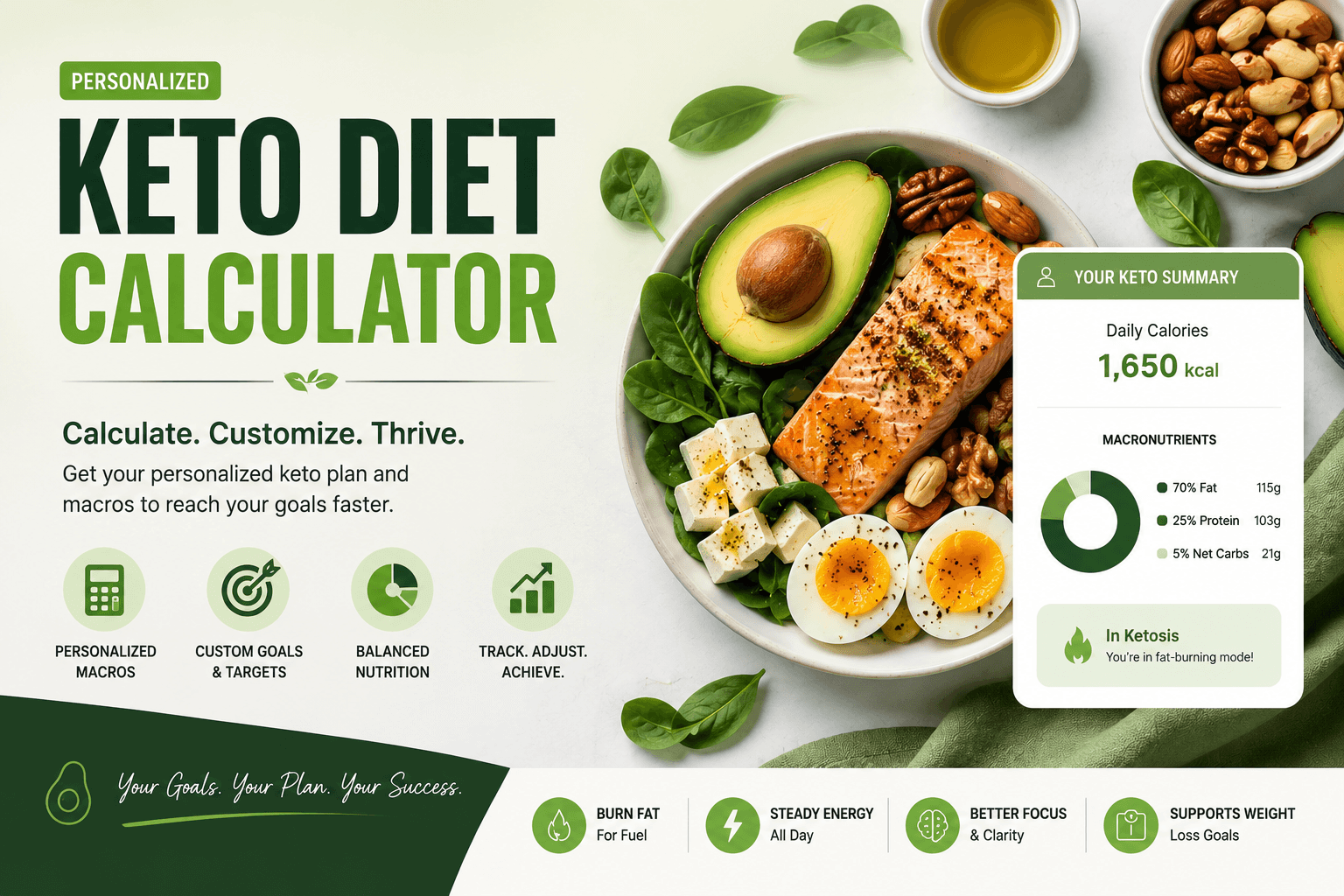
Keto Diet Calculator: How to Calculate Your Exact Carb, Protein, and Fat Macros
Keto Calculator

Start your Keto diet journey with our Keto diet calculator.
Just by giving us the information about your activity, age, height, and weight, we can help you figure out how many calories you should be consuming in each macronutrient – fat, protein, and carbs – every day. With this tool, tracking your macros for a ketogenic diet will become easier than ever!
Features of Our Keto Diet Calculator:
- Calculate the Calories & Macronutrients (Carbs, Proteins & Fats) Required per Day .
- Suggestive Macro targets based on User Goals & Activity Level .
- Achieve keto success without having to manually count macros every day.
- Get personalized suggestions on macronutrient goals and optimal daily calorie consumption.
- Easy to use interface makes changing or adjusting goals a breeze.
Quick Summary
- A keto diet calculator estimates your daily calorie needs and then splits those calories into grams of carbohydrate, protein, and fat using a standard ketogenic ratio — typically around 5–10% carbs, 15–20% protein, and 70–80% fat.
- The calculator works in three steps: it estimates your Basal Metabolic Rate (BMR), multiplies it by an activity factor to get your Total Daily Energy Expenditure (TDEE), then converts your chosen macro percentages into grams.
- You’ll typically need to enter your age, sex, height, weight, activity level, and goal (maintain, lose, or gain weight); advanced versions also let you select a BMR formula or enter body fat percentage.
- Research shows ketogenic diets can produce meaningful short-term weight loss and improved blood sugar control, but long-term benefits and cardiovascular safety are less clear, according to a 2024 review highlighted by Harvard Health.
- A calculator gives you a personalized starting point, not a guarantee — your real-world carb tolerance, activity, and health status still matter.
- People with certain conditions (type 1 diabetes, kidney or liver disease, pregnancy, a history of disordered eating) should talk to a healthcare provider before using calculated keto macros.
Introduction
Typing “how many carbs can I eat on keto” into Google and getting five different answers is one of the most common frustrations for anyone starting a ketogenic diet. Everybody’s calorie and macro needs are different, which is exactly the problem a keto diet calculator is built to solve.
Rather than guessing at a generic “20 grams of carbs a day” rule you saw on social media, a keto calculator uses your actual age, sex, height, weight, and activity level to generate a personalized daily calorie target — then breaks that number down into specific gram amounts of carbohydrate, protein, and fat designed to support ketosis.
This guide walks through exactly how a keto diet calculator works, how to use it step by step, what the underlying science actually supports, and who should — and shouldn’t — use calculated keto macros without medical guidance.
What Is a Keto Diet Calculator?
A keto diet calculator is an online tool that converts your personal stats into a daily calorie and macronutrient target tailored to a ketogenic eating pattern. It’s essentially a specialized version of a TDEE (Total Daily Energy Expenditure) calculator, with the output re-expressed as keto-specific percentages of carbohydrate, protein, and fat instead of a standard balanced diet.
The ketogenic, or “keto,” diet itself is a very low-carbohydrate, high-fat eating pattern. It substantially restricts carbohydrate intake and replaces those calories with fat, with carbohydrates typically making up only about 5–10% of total calories. This forces the body to shift from burning glucose (sugar from carbs) for fuel to burning fat-derived molecules called ketones — a metabolic state called ketosis.
The keto diet isn’t new. It was developed nearly 100 years ago as a medical treatment for drug-resistant epilepsy in children, and it’s still used clinically for that purpose today. Its popularity for weight loss took off decades later, building on the same low-carbohydrate principles popularized by the Atkins diet.
Key Facts at a Glance
| Element | Typical Value |
|---|---|
| Carbohydrate target | 5–10% of total calories (often 20–50 g/day) |
| Protein target | 15–20% of total calories (some versions up to 30–35%) |
| Fat target | 70–80% of total calories |
| Calories per gram (fat) | 9 kcal |
| Calories per gram (carb or protein) | 4 kcal |
| Typical time to enter ketosis | A few days to about a week |
How the Keto Diet Calculator Works (And Why It’s Useful)
A good keto calculator does three calculations behind the scenes. Understanding them helps you trust — and tweak — the numbers it gives you.
Step 1: Estimate Your Calorie Needs (BMR → TDEE)
Your calorie needs are based on your Total Daily Energy Expenditure (TDEE), calculated as:
TDEE = BMR × Activity Factor
Your Basal Metabolic Rate (BMR) is the number of calories your body burns at complete rest just to keep your heart beating, lungs breathing, and organs functioning. Calculators estimate BMR using validated equations that factor in your age, sex, height, and weight. The most common formulas you’ll see in an “advanced options” menu include:
| BMR Formula | Best For |
|---|---|
| Mifflin-St Jeor | The most widely recommended, evidence-based default for most adults |
| Katch-McArdle | More accurate if you know your body fat percentage, since it uses lean body mass |
| Revised Harris-Benedict | An updated version of one of the oldest BMR equations |
| Harris-Benedict (original) | An older formula, less precise than Mifflin-St Jeor by modern standards |
| Schofield | Sometimes used internationally and in clinical/research settings |
Once BMR is estimated, it’s multiplied by an activity factor that accounts for how much you move during the day — from “little to no exercise” up through “heavy physical exercise 6–7 times per week.” The more active you are, the higher your activity multiplier and the more total calories (and therefore macros) you’re allotted.
Step 2: Apply Your Macro Split
After your daily calorie target is set, the calculator applies a macronutrient split. Most keto calculators offer several preset ratios plus a custom option:
| Macro Split Preset | Carbs | Protein | Fat |
|---|---|---|---|
| Standard keto | 5% | 25% | 70% |
| Higher-fat keto | 5% | 20% | 75% |
| Higher-carb keto | 10% | 15% | 75% |
| Higher-protein keto | 5% | 30% | 65% |
| Custom | You choose | You choose | You choose |
Step 3: Convert Calories to Grams
Finally, the calculator divides the calories assigned to each macronutrient by its calorie density to give you grams per day:
| Macronutrient | Calories per Gram |
|---|---|
| Fat | 9 kcal |
| Carbohydrate | 4 kcal |
| Protein | 4 kcal |
Worked Example
Here’s how the math plays out for a moderately active, 35-year-old woman who is 5 feet 5 inches tall and weighs 140 pounds, using the Mifflin-St Jeor formula and the standard 5/25/70 keto split:
- BMR ≈ 1,331 calories
- TDEE = 1,331 × 1.55 (moderate activity factor) ≈ 2,063 calories/day
- Macro calories: 2,063 × 0.05 = 103 kcal from carbs; 2,063 × 0.25 = 516 kcal from protein; 2,063 × 0.70 = 1,444 kcal from fat
- Macro grams: 103 ÷ 4 = 26 g carbs; 516 ÷ 4 = 129 g protein; 1,444 ÷ 9 = 160 g fat
If that same woman wanted to lose about 1 pound per week, she’d reduce her intake by roughly 500 calories/day (to about 1,563 calories), which recalculates to roughly 20 g carbs, 98 g protein, and 122 g fat per day.
This is exactly why a calculator is more useful than a one-size-fits-all carb limit — the right number of grams depends heavily on your size, sex, activity, and goals.
Step-by-Step: How to Use the Keto Diet Calculator
Using the keto calculator on this page takes just a few minutes:
- Enter your age, sex, height, and weight. Choose your preferred units (inches/cm, pounds/kg/stone).
- Select your activity level, from “little to no exercise” up to “heavy physical exercise 6–7 times per week.” Be honest here — overestimating activity is one of the most common reasons people don’t lose weight as expected.
- Choose your nutrition goal: maintain current weight, mild weight loss (½ lb/week), moderate weight loss (1 lb/week), heavy weight loss (2 lb/week), or build muscle/gain weight.
- Pick a macro split from the presets, or select “custom” to enter your own carb/protein/fat percentages (they must total 100%).
- (Optional) Open “Advanced Options” to choose a specific BMR formula or enter your body fat percentage for a more individualized estimate via the Katch-McArdle method.
- Review your results, which display your daily carbohydrate, protein, and fat targets in grams, plus your total daily calorie allowance and how many calories come from each macronutrient.
From there, you can plug your gram targets into a food tracking app and start building meals around them, adjusting every few weeks based on real-world results on the scale and how you feel.
What the Research Says
It’s important to separate what’s well-supported from what’s still emerging when it comes to the keto diet your calculator is helping you plan for.
Strong, Well-Established Evidence
- Short-term weight loss: A 2020 systematic review and meta-analysis in Reviews in Endocrine and Metabolic Disorders found that very low-calorie ketogenic diets produced significant reductions in body weight, waist circumference, BMI, blood pressure, and cholesterol in people with overweight or obesity.
- Greater weight loss than low-fat diets: A meta-analysis of randomized controlled trials published in the British Journal of Nutrition found that people following a very-low-carbohydrate ketogenic diet lost more weight long-term than those on a low-fat diet.
- Appetite control: Multiple reviews note that ketogenic diets can reduce hunger and appetite, which may explain why some people find it easier to stick with than other calorie-restricted approaches, at least in the short term.
- Blood sugar management in type 2 diabetes: A controlled trial published in Nutrition & Metabolism found that a low-carbohydrate ketogenic diet led to greater improvements in blood sugar control — and more medication reductions — than a low-calorie, low-glycemic-index diet in people with type 2 diabetes. A 2020 meta-analysis in Cureus similarly found keto diets superior to control diets for weight, blood sugar, and cholesterol outcomes in people with diabetes.
- Epilepsy: The ketogenic diet has nearly a century of clinical use for reducing seizure frequency in children with drug-resistant epilepsy, making this its most rigorously established medical application.
Mixed or Limited Evidence
- Cardiovascular risk: A 2024 review in Current Problems in Cardiology, summarized by Harvard Health, concluded that the keto diet doesn’t meet standard criteria for a healthy diet and may raise heart disease risk for some people. The review found that while keto can lower triglycerides, it also tends to raise LDL (“bad”) cholesterol, and that short-term improvements in blood sugar and blood pressure tend to fade over time.
- Long-term sustainability: Harvard Health and Mayo Clinic dietitians both note that keto is a highly restrictive diet that’s difficult for most people to maintain for more than a few months, and that long-term health outcomes remain unclear.
- Athletic performance: Evidence is genuinely mixed. Some studies of endurance athletes following very-low-carb diets for 12 weeks found improved body composition and fat-burning during exercise, while other research found no performance benefit — or even reduced training capacity and increased fatigue.
Early/Emerging Research (Not Yet Conclusive)
- Mental health: A small pilot study published in Translational Psychiatry in September 2025 followed 24 college students with major depressive disorder on a ketogenic diet for 10 weeks; among the 16 who completed it, depression symptoms dropped by about 70% on average. The researchers themselves describe this as preliminary, and it has not been replicated in a larger, controlled trial.
- Cancer and neurological disease: Ketogenic diets are an active area of mechanistic and early clinical research for cancer support and neurological conditions, but this remains investigational and should not be used as a substitute for standard treatment.
- Metabolic syndrome: Newer reviews highlight plausible mechanisms by which keto may help metabolic syndrome markers, but call for more rigorous, longer trials before firm conclusions can be drawn.
Potential Risks, Side Effects, and Limitations
A calculator can tell you what to eat, but it can’t manage the real-world tradeoffs of a very low-carb diet on its own.
Short-term side effects (“keto flu”): In the first week or so of cutting carbs drastically, many people experience headache, brain fog, fatigue, irritability, nausea, trouble sleeping, and constipation. These symptoms are generally temporary as the body adapts and tend to improve with adequate hydration, electrolytes, and sleep.
Cholesterol and cardiovascular concerns: Because keto is high in fat — including, often, a substantial amount of saturated fat — it can raise LDL cholesterol in some people, which may increase cardiovascular risk over time, especially if fat sources aren’t carefully chosen.
Nutrient gaps: Cutting out whole grains, many fruits, legumes, and some vegetables can make it harder to get adequate fiber, certain vitamins, and minerals unless the diet is planned carefully around nutrient-dense, low-carb foods.
Kidney stones and gallstones: Some research has linked very low-carb, high-protein/high-fat diets with an increased risk of kidney stones, and the diet is generally discouraged in people with a history of gout or gallstones.
Medication interactions: People taking SGLT-2 inhibitors (common diabetes/heart failure medications) or blood thinners like warfarin should be especially cautious, since keto-related changes in vitamin K intake or ketone levels can interact with these drugs.
Calculator accuracy is an estimate, not a guarantee: BMR/TDEE formulas are statistically derived averages; individual metabolism can vary by several hundred calories in either direction. Calculators also can’t measure your actual carb tolerance, hormone status, gut health, or medication use — all of which affect real-world results.
Who Should Consider Using a Keto Calculator (and Trying Keto)?
A calculated ketogenic approach may be worth considering, ideally with medical or dietitian support, for:
- Adults with overweight or obesity looking for a structured, short-to-medium-term jump-start to weight loss
- People with type 2 diabetes or insulin resistance who want to explore low-carbohydrate strategies for blood sugar control, under medical supervision (especially important if you take glucose-lowering medication, since doses may need adjustment)
- People who’ve tried other calorie-counting approaches and want a different macro structure to experiment with
- Children with drug-resistant epilepsy, under the direct supervision of a neurologist and dietitian (this is a medical use case, not a self-directed one)
- Generally healthy, normal-or-above-weight adults who want to test how their body responds to a high-fat, low-carb eating pattern for a defined trial period
Who Should Avoid the Keto Diet?
Cleveland Clinic dietitians and other experts identify several groups for whom keto is not recommended without close medical supervision, including people who:
- Have type 1 diabetes (risk of diabetic ketoacidosis, a dangerous condition distinct from normal nutritional ketosis)
- Have end-stage renal (kidney) disease or significant kidney impairment
- Have liver failure or significant liver disease
- Are currently undergoing active cancer treatment
- Have had a recent stroke or heart attack, or have cardiac arrhythmias
- Are pregnant or breastfeeding
- Have current gout or gallstones
- Are children outside a supervised medical epilepsy program
- Are underweight or at a normal/healthy weight already, since calculated deficits may not be appropriate
- Have a history of disordered eating, given the highly restrictive nature of the diet
If any of these apply to you, talk with a physician or registered dietitian before using a calculator’s keto macro recommendations — and never adjust diabetes medications based on a calculator alone.
Understanding Your Results: Recommended Macro Ranges
For context, it helps to know how keto macro ranges compare to general nutrition guidance. The U.S. Dietary Reference Intakes set an Acceptable Macronutrient Distribution Range (AMDR) for the general healthy adult population at:
| Macronutrient | General AMDR (Healthy Adults) | Typical Keto Range |
|---|---|---|
| Carbohydrate | 45–65% of calories | 5–10% of calories |
| Protein | 10–35% of calories | 15–20% (up to ~35% in some versions) |
| Fat | 20–35% of calories | 70–80% of calories |
This table shows just how far outside typical nutrition guidance the ketogenic diet sits — which is exactly why a personalized calculator (rather than a generic carb count from social media) matters, and why ongoing medical guidance is reasonable for many people attempting it.
On net carbs: Many keto calculators and food labels reference “net carbs,” calculated as:
Net Carbs = Total Carbohydrates − Fiber − (½ × Sugar Alcohols)
This matters because fiber isn’t digested and absorbed the way other carbohydrates are, and sugar alcohols are only partially metabolized — so many people on keto track net carbs rather than total carbs to stay within their calculated limit while still eating fiber-rich vegetables.
Best Keto-Friendly Food Sources to Build Around Your Macros
Once your calculator gives you gram targets, these everyday foods make it easier to hit them:
| Food | Serving Size | Net Carbs (g) | Protein (g) | Fat (g) |
|---|---|---|---|---|
| Salmon | 3 oz, cooked | 0 | 22 | 7 |
| Eggs | 1 large | <1 | 6 | 5 |
| Avocado | ½ medium | 2 | 1 | 11 |
| Extra-virgin olive oil | 1 tbsp | 0 | 0 | 14 |
| Almonds | 1 oz (~23 nuts) | 2 | 6 | 14 |
| Spinach (raw) | 1 cup | <1 | 1 | 0 |
| Broccoli (cooked) | 1 cup | 4 | 4 | 0.5 |
| Cheddar cheese | 1 oz | <1 | 7 | 9 |
| Chicken thigh (skin-on) | 3 oz, cooked | 0 | 21 | 13 |
| Plain Greek yogurt (full-fat) | ¾ cup | 5 | 13 | 8 |
| Raspberries | ½ cup | 4 | 1 | 0 |
| Chia seeds | 1 tbsp | 1 | 2 | 4 |
Choosing mostly unsaturated fats (olive oil, avocado, nuts, fatty fish) over heavily saturated sources (butter, fatty red meat, coconut oil) is one practical way to apply your calculated fat target while addressing the cholesterol concerns raised in the research above.
Frequently Asked Questions
How accurate is a keto diet calculator?
It’s an evidence-based estimate, not an exact measurement. BMR and TDEE formulas like Mifflin-St Jeor are well-validated on average but can be off by a few hundred calories for any individual. Treat your result as a starting point and adjust every 2–3 weeks based on real progress.
What’s the difference between a keto calculator and a regular macro calculator?
A standard macro or TDEE calculator typically uses balanced ratios (close to the general AMDR), while a keto calculator forces the same calorie target into a much higher fat, much lower carb percentage split designed to support ketosis.
Which BMR formula should I choose?
Mifflin-St Jeor is the most commonly recommended default for the general population. If you know your body fat percentage accurately (from a DEXA scan or reliable body composition test), Katch-McArdle can be more precise because it accounts for lean body mass.
Should I track total carbs or net carbs?
Most keto dieters track net carbs (total carbs minus fiber and half of sugar alcohols), since fiber doesn’t raise blood sugar the way digestible carbs do. Check which one your specific calculator and food tracking app use, since mixing the two can throw off your numbers.
How many carbs can I eat and stay in ketosis?
It varies by person, but most people need to stay under roughly 20–50 grams of net carbs per day to maintain ketosis, which is why a calculator’s personalized gram target is more useful than a single universal rule.
Do I need to recalculate my macros over time?
Yes. As you lose weight, gain muscle, or change your activity level, your BMR and TDEE shift too. Recalculating every 10–15 pounds lost, or every few months, keeps your targets accurate.
Is the keto diet safe to follow long-term?
Current evidence on long-term safety is limited and mixed. Some reviews flag potential cardiovascular concerns from sustained high saturated fat and elevated LDL cholesterol, which is why many clinicians suggest using keto as a structured short-to-medium-term tool rather than a permanent diet, then transitioning to a more balanced, Mediterranean-style pattern.
What if I follow my calculated macros but don’t lose weight?
This is common and usually means your actual activity level or portion sizes don’t match what you entered, your TDEE estimate needs adjusting, or water retention/stress/sleep are masking fat loss. Tracking food intake for a week and reassessing is the most reliable fix.
Can athletes or bodybuilders use a keto calculator?
Yes, but results are individual — research on low-carb diets and athletic performance is mixed, with some studies showing improved fat-burning and body composition and others showing reduced training capacity. Athletes should consider a higher-protein keto split and monitor performance closely.
Is keto the same as “low-carb”?
Not exactly. All keto diets are low-carb, but not all low-carb diets are ketogenic. True keto restricts carbs enough (usually under 10% of calories) to induce ketosis; many general “low-carb” diets allow more carbohydrate and don’t necessarily produce measurable ketosis.
Expert Insights
Registered dietitians consistently emphasize the same practical points: a calculator gives you a scientifically grounded number, but the food choices you make to hit that number matter just as much as the number itself. Choosing nutrient-dense, minimally processed fats and proteins — fatty fish, eggs, olive oil, nuts, and non-starchy vegetables — rather than relying heavily on processed meats and saturated fats, helps address some of the cholesterol and nutrient-density concerns raised in recent research.
Physicians who work with the ketogenic diet clinically also stress individualization: people with diabetes, kidney conditions, or cardiovascular disease should never start a calculated keto plan without medical oversight, since the diet can require medication adjustments and carries real, documented contraindications for specific health conditions.
Bottom Line
A keto diet calculator takes the guesswork out of starting a ketogenic diet by turning your personal stats into a clear daily target: a set number of calories split into specific grams of carbs, protein, and fat. The math behind it — BMR, TDEE, and standard keto macro ratios — is well-established and grounded in nutrition science.
What the calculator can’t do is replace clinical judgment. The research on ketogenic diets shows real, evidence-backed benefits for short-term weight loss and blood sugar control, alongside legitimate concerns about cholesterol, long-term sustainability, and safety for certain medical conditions. Use a calculator to get your personalized starting numbers, build your plate around nutrient-dense low-carb foods, reassess your macros every few weeks, and loop in a healthcare provider if you have any underlying health condition — especially diabetes, kidney or liver disease, or heart disease.
References
- Harvard Health Publishing. “Keto diet is not healthy and may harm the heart.” 2024. health.harvard.edu
- Harvard Health Publishing. “Should you try the keto diet?” 2024. health.harvard.edu
- Harvard Health Publishing. “Can the keto diet help me lose weight?” 2024. health.harvard.edu
- Mayo Clinic Diet. “How to make the keto diet healthy.” 2025. diet.mayoclinic.org
- Cleveland Clinic. “What Is the Keto Diet and Should You Try It?” 2022. health.clevelandclinic.org
- Cleveland Clinic. “Choosing a Heart Healthy Diet” (Love Your Heart podcast transcript). my.clevelandclinic.org
- Daley, S.F., et al. “The Ketogenic Diet: Clinical Applications, Evidence-based Indications, and Implementation.” StatPearls, NCBI Bookshelf. 2025. ncbi.nlm.nih.gov
- Crosby, L., et al. “Ketogenic Diets and Chronic Disease: Weighing the Benefits Against the Risks.” Frontiers in Nutrition, 2021. doi.org/10.3389/fnut.2021.702802
- Castellana, M., et al. “Efficacy and safety of very low calorie ketogenic diet (VLCKD) in patients with overweight and obesity: A systematic review and meta-analysis.” Reviews in Endocrine and Metabolic Disorders, 2020. link.springer.com
- Zhu, H., et al. “Ketogenic diet for human diseases: the underlying mechanisms and potential for clinical implementations.” Signal Transduction and Targeted Therapy, 2022. doi.org/10.1038/s41392-021-00831-w
- Bueno, N.B., et al. “Very-low-carbohydrate ketogenic diet v. low-fat diet for long-term weight loss: a meta-analysis of randomised controlled trials.” British Journal of Nutrition, 2013. cambridge.org
- Westman, E.C., et al. “The effect of a low-carbohydrate, ketogenic diet versus a low-glycemic index diet on glycemic control in type 2 diabetes mellitus.” Nutrition & Metabolism, 2008. nutritionandmetabolism.biomedcentral.com
- Alarim, R.A., et al. “Effects of the Ketogenic Diet on Glycemic Control in Diabetic Patients: Meta-Analysis of Clinical Trials.” Cureus, 2020. ncbi.nlm.nih.gov
- Bostock, E.C.S., et al. “Consumer Reports of ‘Keto Flu’ Associated With the Ketogenic Diet.” Frontiers in Nutrition, 2020. doi.org/10.3389/fnut.2020.00020
- National Academies of Sciences, Institute of Medicine. “Dietary Reference Intakes for Energy, Carbohydrate, Fiber, Fat, Fatty Acids, Cholesterol, Protein, and Amino Acids” (Acceptable Macronutrient Distribution Ranges). 2005. nationalacademies.org
- National Institutes of Health, PMC. “Optimizing Protein Intake in Adults: Interpretation and Application of the Recommended Dietary Allowance Compared with the Acceptable Macronutrient Distribution Range.” pmc.ncbi.nlm.nih.gov
- Inch Calculator. “Keto Calculator – Calculate Your Macros,” reviewed by Holly Smith, DO, and Elise Harlow, MS, RDN. 2025. inchcalculator.com
- The Healthy. “Following This Popular Diet Improved Brain Health in 70% of People, Says Pilot Study” (reporting on Translational Psychiatry, September 2025 study). 2026. thehealthy.com
- WFAE/NPR Health. “The 12 biggest Keto diet dangers to know.” 2026. wfae.org
- Statista. “Ketogenic diet market – statistics & facts.” 2026. statista.com
Medical Disclaimer: This article is for informational and educational purposes only and is not a substitute for professional medical advice, diagnosis, or treatment. Always consult a physician or registered dietitian before starting a ketogenic diet, especially if you have an existing health condition or take prescription medication.

What is Keto Diet?
The Keto diet, often known as the ketogenic diet, is a very low-carb, high-fat diet that has many similarities to the Atkins and low-carb diets. It entails substantially lowering carbohydrate consumption and substituting fat. It’s Hightly Effective on reduce your weight.



Please Rate this page